


Yes, Lean Thinkers Are Luddites. The Original Kind.
FEATURE – The original Luddites didn’t hate machines; they fought over how they were used and for what purpose. Lean thinkers do the same with AI, but often forget to ask who gains.
Words: Roberto Priolo
“Rosie the Riveter is still an expense, but Rosie the Robot is an investment.”
As the AI rush continues and fears swirl that this technology will replace people en masse, you might be forgiven for believing that sentence came out of this morning’s headlines. In fact, Bruce Hamilton said it in January 2019, as the business world was getting excited about Industry 4.0, drawing on what he had witnessed during the “lights-out” automation craze of the 1980s. Back then, he argued, companies poured billions into technology while overlooking the people who did the work, and had little to show for it.
News of Bruce’s passing reached us just before last week’s Lean Global Connection (LGC), a 24-hour virtual gathering in which more than 140 speakers from every continent wrestled with the very question he had raised. Before turning to what they concluded, it is worth pausing on Bruce.
John Shook described him from the LGC stage as one of the pioneers of the U.S. continuous improvement community for the last forty years, someone who “got involved with Shingo way back in the eighties.” From the late 1980s, at United Electric, Bruce hosted several Japanese lean teachers, including Shigeo Shingo and, later, Hajime Ohba, the first and longtime manager of the Toyota Production System Support Center (TSSC). He never forgot that Shingo’s first request was to go to the gemba. “You have to go see to understand,” Bruce would later say.
As president of GBMP, he went on to make one of the most widely used introductions to continuous improvement: Toast Kaizen, a short video in which he makes the breakfast staple. Challenged by his sensei to show his own commitment to kaizen, Bruce turned his kitchen into a gemba. Nearly thirty years on, as Josh Howell put it at the event, many who don’t know his name know him as “the Toast Dude.” Bruce’s point was that improvement is “not so much about the work but all the things that get in the way of the work.”
The idea of looking at everything around the work before reaching for a fix has fundamentally shaped how the lean community welcomes every new technology. Watch the video again and you’ll notice the toaster is not the problem — everything around it is. The industry experienced this in the 1980s, when GM poured tens of billions of dollars into robots and automated plants. Meanwhile, at NUMMI, the joint venture with Toyota that John Shook helped launch, people working a well-designed system, on older equipment, outperformed those highly automated plants. That isn’t to say that Toyota is against machines. In fact, in 1989, Toyota was running what was then the world’s first fully automated cylinder head sub-assembly line, a project Art Smalley worked on, while still developing the people who ran it. As Art puts it, treating Toyota’s system as purely a “people” system “is not wrong but it is historically incomplete.”
Look at ERP systems or AI the way Bruce looked at his toaster, and the advice is always the same: take the time to understand and fix the process first. Say it often enough, and sooner or later someone calls you a Luddite.
ARE WE LUDDITES, THOUGH?
In the early 1810s, with bread prices soaring after failed harvests and trade choked by the war with France, English knitters had little margin left to absorb a pay cut dressed up as progress. So when Nottinghamshire hosiers began using wide frames to churn out cheap, poorly made “cut-up” stockings with less-skilled labor, and to pay below the agreed rates, the knitters fought back. Signing their threats in the name of a mythical “General Ludd,” they broke into workshops at night and smashed frames.
They were not mindless machine-breakers, however. Writing to the Home Office in February 1812, a Nottingham magistrate observed that “resentment against those hosiers who paid the under-price” had been the leading feature of the unrest. The picture was less tidy in Yorkshire, where croppers attacked the shearing frames that could do their skilled work outright. Even there, though, the anger was aimed at the mill owners who used the machines to put them out of work. Across the movement, the Luddites’ quarrel was less with the machine itself than with the terms on which it arrived: who it enriched, whose skill it erased, what it did to the quality of the work. Two centuries on, the name has outlived the argument: “Luddite” now means anyone who resists technology.
Lean thinking has suffered a similar flattening. To many outsiders, we are the old-fashioned crowd, wary of anything with a screen. A few years ago, chatting with a stranger about technology in business, I mentioned that I run a magazine on lean thinking. His tactful reply: “Oh, that old thing?”
I understand where that comes from — and we haven’t always helped ourselves. Skim our headlines from the last tech wave and you might conclude that we are Luddites in the modern sense: Why We Believe People-Free Plants and Services Prevent Learning, Developing People Not Robots Through Karakuri, Tesla vs. TPS: Seeking the Soul in the New Machine. But if you read past those headlines, you’ll realize that none of these pieces says no to technology. They object to technology that replaces people’s thinking instead of supporting it, and to automating a process nobody has bothered to fix.
In other words, as lean thinkers, we are Luddites only in the original sense: we care about the terms on which a technology arrives. Most of those terms we have learned to insist on. One of them we still find easy to skip, and I’ll come back to it. Toyota shows what insisting on those terms looks like at scale. When five Toyota Group companies announced a joint push into AI in May 2025, they paired it with a software academy to train their own people, and framed the whole effort as an extension of jidoka, the principle of automation with a human touch, dating back to Sakichi Toyoda’s self-stopping loom. The machine is given enough judgment to stop when something goes wrong, and people use that stop to find and fix the cause. Last week’s Lean Global Connection showed how many other organizations are trying to strike the same balance.
ENGAGEMENT, NOT RESISTANCE
For the past four years, I have curated the Lean Global Connection program and proposed its theme. This year’s was designing human-centered organizations in the age of AI. In the two previous editions, when the themes were adaptiveness and leadership, AI came up unprompted in about one session in twenty. As Josh Howell said during his reflections at the end of the event, “last year we barely talked about this.” This year we made AI the theme, and the community had enough real experiments and experience to fill around half of the 24-hour program. The rest stayed on what lean has always been about: value and its creation, teamwork, performance management, problem solving, etc. What struck me most was the kind of proposals we received, which overwhelmingly started from a problem, rather than arguing the tool alone was the answer.
Our archives tell an even longer story. Using AI, I ran a keyword search across the Lean Post and Planet Lean archives, more than 3,000 articles, to see how our community has responded to earlier waves of technology and new ways of working. What I found was a striking pattern. Agile, the outside idea we argued with longest, appeared in around 5–10% of articles through the 2010s; we questioned it and absorbed what worked. The technology waves of the late 2010s got a cooler welcome: Industry 4.0 and the return of “lights-out” automation rarely topped 2–3% of what either publication ran, and the Lean Post titles could often read as defensive. AI is a different story, and this year it comes up in more than a quarter of Planet Lean articles and about half of Lean Post ones.
The tone has changed too, from guarding the gate to reporting experiments. As Art Smalley argued last month, adoption inside organizations will lag far behind the technology. But the willingness to experiment is already here. What the archive shows is a community that has always rejected technology sold as a substitute for thinking or an off-the-shelf solution unto itself, and that is now taking up a technology it thinks can extend thinking, on its own terms and at the gemba.
THE QUESTIONS A TRUE LUDDITE WOULD ASK
Listen to the strongest cases from this year’s LGC and three questions keep coming up. Nobody asked, “Should we use AI?” Instead, they asked the questions the original machine-breakers were asking, but as people who would rather redesign the machines than break them.
- Which process will it land on? At ANTAM, an Indonesian nickel producer, a team built a machine-learning model to recommend how much reductant to feed the smelter. The algorithm turned out to be the easy part. The hard part was the data going in, which arrived late or unreliable. So before retraining anything, the team built a validation process for its inputs and kept the model advisory: it recommends, but the operators decide. They report a return of more than 100 times the investment.
- Who keeps the judgment and the learning? At Bosch, problem reports used to be manually documented. Now an AI assistant takes the operator’s spoken account and asks follow-up questions, the kind a good team leader would ask, until the problem is properly described. And the tool asks for thinking, instead of replacing it. John Shook showed something similar from the University of Michigan, where an AI coach pushes students to sharpen their own problem statements, and Matt Savas raised the obvious worry: when a machine needs so little instruction from us, will we keep learning to think?
- Whom is it for? FPZ, an Italian manufacturer, first came to LGC in 2024 to present its generative AI project, CESARE. This year, Mauro Mantovanelli came back to tell us why it failed. The solution was pushed out before anyone asked what people needed. Their lesson was to move from AI push to people pull. FPZ went back to those doing the work and started building AI solutions from their real needs, the kind people want to use rather than put up with. Another company in Italy, Würth Italia, asked that question from the start. HR and IT led its rollout together, training AI Champions inside each department; where employees had a champion to work with, three in four took up the tools. Working with their champion, a team built an agent in a few hours that drafts customer proposals from the company’s past projects, and a team member still checks and adapts every one. That is what Tyson Heaton means when he writes that “AI democratizes technical knowledge”: past experience that once lived in the heads of a few people is now available to all. At Würth, it worked because the front-line people themselves were the ones doing the democratizing.
None of these teams rejected the machine. They each refused to let it land on a broken process, to let it take the thinking away, or to let it be done to people rather than with them.
But there is a fourth question, the one the original Luddites asked first: who gets the gain? We haven’t been as good at this question as we have been at the first three. Lean insists that improvement should never cost anyone their job, but too many “lean transformations” have resulted in headcount reductions, and the workers have noticed. Toyota learned the lesson the hard way: after the layoffs and strike of 1950, job security became the price of kaizen. With AI, the gains will come faster and be harder to see. They won’t look like a job replaced, but like an hour saved here and there across everyone, easily absorbed into more work unless someone decides where it goes. At the LGC, ME Elecmetal showed what asking the question looks like, describing AI as talent development rather than cost cutting. Until asking it becomes the norm, we are only half the original kind of Luddite.
So here is a prediction worth checking in a couple of years: the organizations that get lasting value from AI will be the ones that asked who gets the gain before deploying, not after. You’ll be able to tell them apart by where the hours go. Will they go back to the people doing the work, or off the payroll altogether? This question will be on my list as we PDCA our way to the next edition of Lean Global Connection.
WHERE DO WE GO NEXT? IT'S A MATTER OF CHOICE
At the closing of LGC, Josh recognized that something is fundamentally different about this technology. “AI’s relationship to lean thinking is genuinely new. [What we witnessed in the last 24 hours] is not just the traditional tech-versus-lean conversation, but it is recognizing that this technology is different. This isn’t just a technology like we’ve encountered before,” he said.
Above all, the difference is speed. Josh noted that what Tyson Heaton told the Lean Global Network at its annual meeting in September had already evolved by the time LGC happened, a mere two months later.
That pace is exactly where lean thinkers have an advantage. As I said in the closing session, we know we’re never done learning, so we come to AI expecting a steep learning curve. This doesn’t scare us as much as it might somebody who doesn’t practice lean thinking. The habits are already in place: run the experiment, check what happened, adjust, run the next one. And a technology that changes every few months calls for exactly that rhythm, not a perfect plan. John Shook agreed: “It doesn’t necessarily scare us, and what it drives us to do is to get our hands dirty and experiment with it.” For a world watching AI with mixed fear and hype, that may be the lean community’s most useful contribution.
For John, the biggest lesson of the 24 hours was choice. The things we fear, from lazy thinking to lost jobs, “will probably happen,” he said, if “we don’t make these choices to proactively decide how we want to use it.” Choosing well guarantees nothing, but not choosing guarantees we lose control over what happens next. The Luddites saw the choice clearly, but had no say in it. We do.
Bruce saw this coming. His Rosie line was never a complaint about robots; it was about the books, where people show up as a cost and machines as an investment. Nearly eight years on, AI hands leaders the same choice on a far bigger scale. The robot can be an investment in Rosie, if leaders choose to make it one.
THE AUTHOR

Read more


RESEARCH – A recent report by the National Audit Office looks at what works and what doesn’t when lean management is applied in UK government organizations.

FEATURE – If we see lean thinking as a paradigm, which we do, then we should be able to define a set of values this paradigm is built on. So, are there lean ethics? Michael Ballé identifies 10 undisputed lean values, plus one.


INTERVIEW – Convinced that a product that is correctly engineered is easy to manufacture, this product development unit relies on lean thinking to ensure its remotely operated vehicles perform at their best.
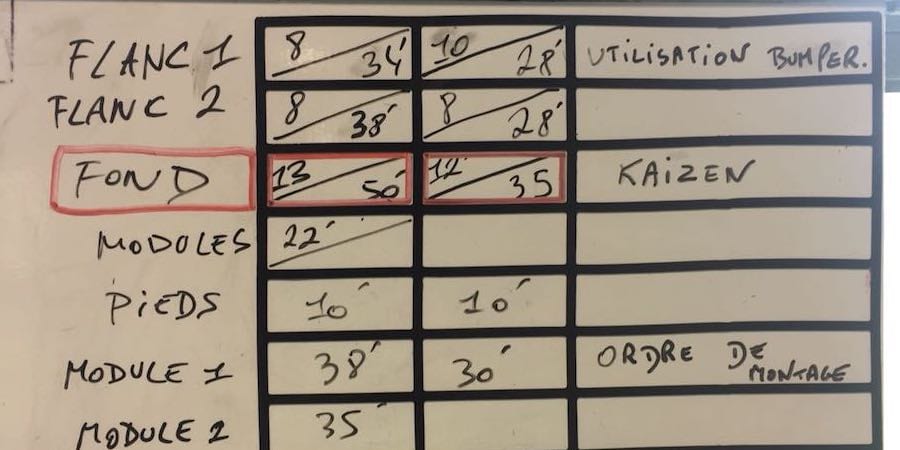
THE TOOLS CORNER – Standardizing the work is one of the fundamentals of lean thinking, but without a yamazumi chart visualizing it (and helping us to streamline it) this is impossible.
Read more
FEATURE - This year’s Lean Global Connection - and the campaign we have devised to promote it - reminds us that there is a fundamental thing AI cannot replicate: human creativity and resolve.

CASE STUDY – Our editor visits TEB, a social enterprise in Barcelona that’s relying on simple kaizen and a growing improvement culture to stay competitive and fulfil its all-important mission.

FEATURE – Drawing on lean's history, the author explains why organizations adopt AI more slowly than it advances, and what it really takes to close the gap.

COLUMN – In this column, different lean and technology experts answer the same pressing question shaping today’s tech/AI debate. This month, the question on everyone's mind: will AI really take our jobs?