

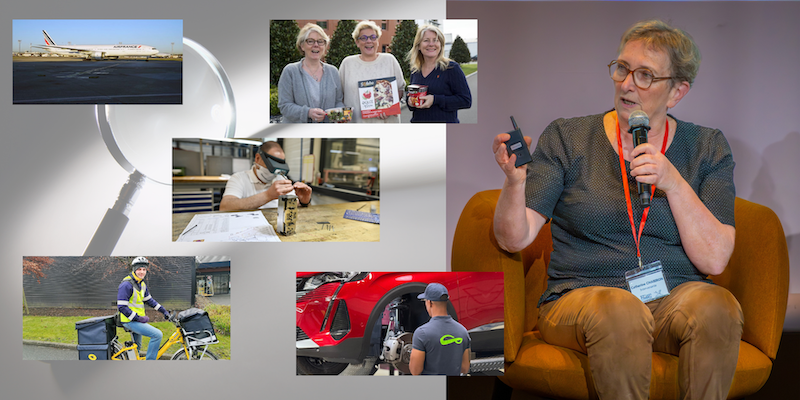
A decade at the gemba, taking notes
INTERVIEW – Over the past decade, Catherine Chabiron’s Notes from the Gemba series has turned into some of the most insightful content on Planet Lean. Our editor sits down with the author to talk genchi gembutsu, writing, and building a lean community.
Interviewee: Catherine Chabiron
Roberto Priolo: Ten years ago exactly, Planet Lean published the first article from your Notes from the Gemba series. Since then, with 50+ articles, NFTG has become one of the magazine's most important contributions. What has the series come to represent for you as a person and a student of Lean?
Catherine Chabiron: Undoubtedly both a learning experience and a human adventure.
As I tour plants, offices, or sales points, I learn a great deal, starting with how to extract a compelling story from the huge amount of data, anecdotes, failures and successes I collect from the gemba. But this is also an opportunity to share what I have seen elsewhere, and my own experience from the automotive world. It’s always very rewarding and fun.
I see it also as a human adventure because it is the best way to reach out to our community of ideas here in France. Going to their gemba, rather than hearing them in conference rooms (which is also needed, by the way), is an opportunity for face-to-face, contextual exchange. The resulting story shows a practical way to reach a sustainable company growth and, by so doing, it offers an alternative to financial management and technology revolution as the sole drivers of performance.
RP: To write your column, you've had to master the art of genchi genbutsu (going see). In your mind, what makes for a successful gemba walk?
CC: Obviously, you need time to observe and use all your senses. You don’t want things to be pointed out or served to you on a silver platter. And if questions are needed, the only permitted ones are open questions: how does this work? What are you trying to achieve? Is there a better way to do it?
Observation without intent is also pointless. Ohno would have his teams check overproduction wastes or whether the work could be done with fewer people. Each Notes from the Gemba article is prepared with a specific intent in mind, a red thread, be it how serious a company is about developing skills, how to manage a supply chain with the shortest lead-time and top quality, or whether conflicts help performance or not. Observing with intent requires the support of a mental framework (TPS, Process and Product Development…) and a bit of background investigation if you’re new to the trade, competition, technologies at stake, and so on.
RP: You have visited countless organizations on their lean journeys. Is there one that stands out? Or which you have a particularly fond memory of?
CC: Each visit has been a great human encounter. Observing how Lean drives performance in environments as different as manufacturing, food industry, postal services, hospitals, tech firm, web marketing companies, or a football club (stay tuned…) is very rewarding. It makes me have faith in humanity and its ability to carry out complex endeavors through human relations (no matter how contentious) and constant learnings. With the help of the TPS, of course.
Having said that, I have fond memories of my very first encounter with Klaus Beulker in Germany. This was going to be a one-time article, just to highlight the great work Klaus was doing at Terex Cranes. Little did I know, during my visit, I had created the Proof of Concept for Notes from the Gemba.
RP: Many of the NFTG columns have been included in two books you have published in the last few years. In your opinion, why is it so important to document lean transformations?
CC: First of all, we owe it to lean leaders, lean officers and their teams. Those people have taken the risk to embrace Lean, to swim against the tide, because they believe in it.
Secondly, they are on the gemba, developing people and achieving real results. It would be a such a waste not to share their experience with others. Remember, managers and leaders can only be convinced to manage in a different way either by recognized experts or by their peers. Through Notes from the Gemba, I am trying to promote a circle of influential peers.
Lastly, to use a word you recently used, we need to become leanfluencers. In a world in which new technologies and financial management—if not unbridled capitalism—seem to be the only ways to drive productivity and performance, the voice of Lean must be more convincing, persistent and loud than ever.
RP: As a keen observer of the lean movement, what is your take on the current AI revolution? What does artificial intelligence mean for lean organizations?
CC: AI has fully hit code development already, and there is no question that its swift adoption and mastery have become key to surviving in the tech world today. Other sectors are still trying to find out what’s in there for them. But one thing is sure: these days, AI is being offered to companies at an increasing cost, which means that how to best use it, now and into the future, will be their primary concern. Lean teaches us that technology should either help create value for customers or make gemba people’s life easier; not accelerate reporting or develop new top-down “best practices.”
Beyond that, we must remember what Toyota has taught us: how can we best serve society as a whole? Deskilling people because AI takes over is a major risk, for us and for the generations to come. How do we continue to learn if debugging and rework is made cheap? How do we reskill people who lose their job to AI? How do we want to share the benefits of AI, as mankind?
RP: After observing and writing about so many transformations, what are the key lessons you have learned about what makes or breaks a lean turnaround?
CC: I would say consistency is one of the key lessons: leaders need to be consistent in their message to the teams, through their gemba visits, their questioning, their challenges. Whatever the competition or external or internal pressure, stick to it, trust your teams’ creativity and develop their problem-solving skills. A change in leadership (we have seen it far too often) often stops or derails the adoption of Lean and the transformation Lean enables. This means you must prepare the next generation, the future leaders. And this is also true of the local lean communities: empower people to become champions of Lean beyond their organizations.
THE INTERVIEWEE

Read more

FEATURE – PL readers will likely be familiar with IOV, the cancer clinic in Brazil that’s become a reference for lean healthcare for countless organizations. Here, Dr Fred looks back at IOV’s 15-year journey.

FEATURE – Reflecting on the transformations he has supported, the author provides a few recommendations on how to get products to market faster.

FEATURE — This team at a Scottish university has developed a visual control for bodily fluids that is solving a messy problem in healthcare.

FEATURE – Aligning supply flows with demand is crucial to success, but it can be complicated. Lean Thinking can help us identify the strategy and sequence of activities that we need to make it a reality.
Read more

NOTES FROM THE GEMBA – After re-insourcing its bike repair workshop, a distribution center of France's La Poste has begun to recover long-lost knowledge about the work of mailmen and using it to innovate.

NOTES FROM THE GEMBA - Alliance MIM navigates market crises leveraging Lean Thinking, emphasizing flow, maintenance, deep process knowledge, and visible learning to stay competitive in a complex, high-precision manufacturing environment.

NOTES FROM THE GEMBA – The author explores how France’s Lean community evolved through gemba practice, kanban-driven engagement, communities of practice, and a flywheel model turning shared learning into momentum.

NOTES FROM THE GEMBA – How do you kick off a lean journey? This French company has chosen to begin by analyzing and tackling each customer complaint.