

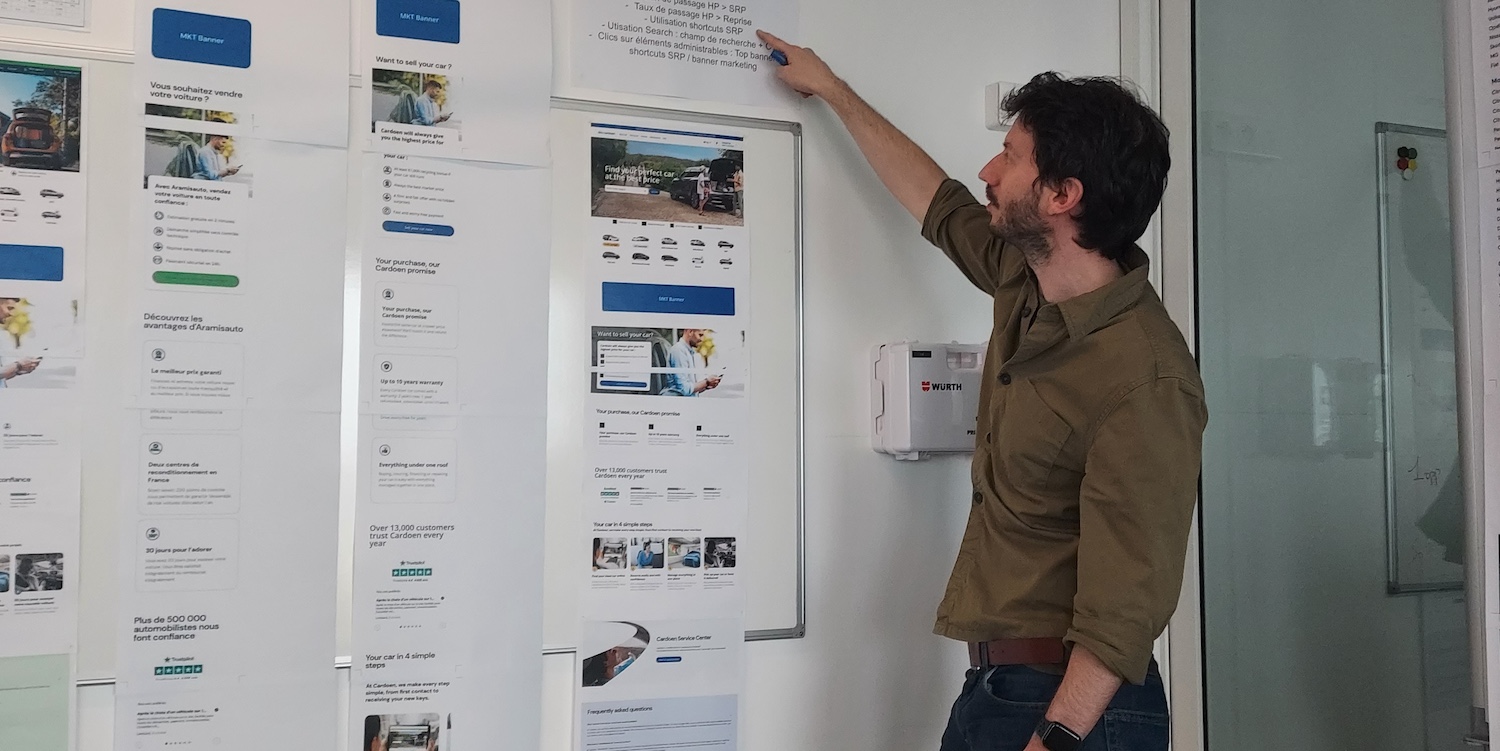
How Aramisauto's web team shapes the customer experience
NOTES FROM THE GEMBA – In the last article about Aramisauto’s transformation, the author discovers how Lean shapes the website behind millions of customer interactions every month.
Words: Catherine Chabiron
After diving into Aramisauto’s approach to its supply chain and exploring its car reconditioning factory, this new gemba walks leads me to the company’s Head Office for an inside look at their website-consulted by 3.2 million people every month. The importance of the website cannot be stressed enough: it represents a customer’s first interaction with the brand. Its design and functionality are essential in shaping their perception and guiding their decisions.
Today, I am here to see Cyril Gras, who took over the position of Head of Customer Digital Experience in May 2024 after a more corporate, albeit very hands-on, role as Lean Officer. He admits it himself: “I had no experience in this type of position.” The challenge was clearly defined: the website team needed to develop their negotiation skills (which are inherent to any improvement process), practice PDCA more systematically, and develop their ability to collaborate.
Fieldwork is essential for understanding complex situations. In my diary, I don't have meetings, I have gemba visits. Similarly, taking on a new responsibility is an opportunity to discover and address value stream issues.” - Romain Boscher, MD of Aramisauto France

In her book Learning to Lead, Leading to Learn , Katie Anderson recounts the professional experience of Isao Yoshino and his colleagues at Toyota and clearly shows how the company’s management approaches each new position with the full DNA of the Toyota (Thinking) Production System and the Toyota Way. I am curious to see whether mastery of lean concepts and guidelines, acquired as a Lean Officer, is helping Cyril as he takes on a position where one does not initially have a command of the technical aspects.
TPS MINDSET HELPS YOU ASK THE RIGHT QUESTIONS
“Yes, it really helped me,” Cyril tells me. “In several ways. I used the fundamentals of 5S and TPM (Total Productive Maintenance) to clean up and master the environment and models of our sites. The roles of the team leaders have been clarified. I approach maintenance, support and investment costs with a real Production Plan, which I strive to level out in terms of task mix and timing.”
I can also see on the walls all the visualizations that the team has developed and that we are going to go through.
“I hold dojos with the product managers,” adds Cyril, “particularly on what we prioritize in change requests (there are a lot of them). We take a piece and they decide whether to approve it or not. Almost every time, there is a trade-off to be made between the value provided and the cost of the solution. So, we discuss the art of negotiation, how to challenge the why and the need, and console people, if necessary, whenever they have to give up their idea.”
This managerial approach to the dojo begins at the Comex: our discussions are an opportunity to learn the art of presentation, negotiation, strategic leadership and PDCA." - Romain Boscher
NOTHING BEATS FLOW ANALYSIS
The primary challenge was to gain an in-depth understanding of the website's underlying system. How can you make decisions about a website without understanding its dependencies? The slightest acceleration on the left can create congestion on the right, and a change in data structure can impact the entire flow.
Cyril strongly encouraged Bruno and his team of website engineers to draw up a complete architecture diagram, including data and information flows. It was a difficult exercise that required time and energy, but they took it very seriously and it proved to be a real game changer: they were able to better understand the interdependencies and agree on how the system worked.
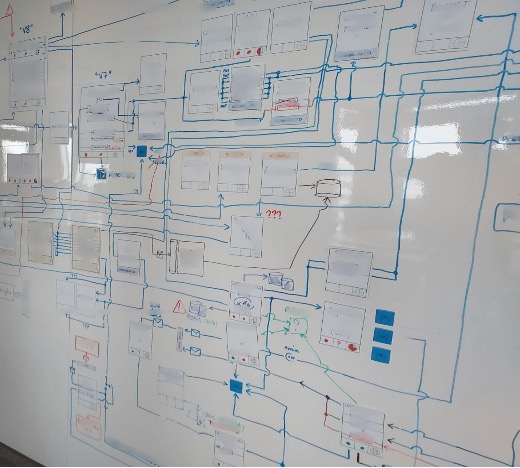
For each subsystem, they investigated the potential impact on customers, the interfaces (APIs) with the rest of the system, the available technical expertise, its security, its maintainability, and so on. The aim was to understand in detail how all these elements fit together and detect potential weaknesses.
The initial reactions, understandably, were along the lines of, “That's pointless, we know how it works.” But once the initial resistance was overcome, the visualization exercise proved useful for everyone and demonstrated the importance of understanding how the development of a new feature could impact the entire system.
Management through visualization is very powerful: it allows you to see what team members have in mind in terms of understanding and planning. Focusing the team's visuals on the value stream can also change their minds about something that was previously misunderstood.” - Romain Boscher
Such an exercise requires perseverance because you go into detail, you question, you observe, you dig deeper. A macro exercise is based solely on what we think we know. It is the accuracy of the information collected or observed on each flow and subsystem that enables real learning. Unsurprisingly, those in the team who really wanted to learn came forward, with a desire to build systems that would last over time and help customers.
Cyril has since sought to involve the website engineers in everything that is likely to create more meaning for them: they helped to co-construct the architecture diagram and participated in kaizen exercises to speed up page loading. “This allows us to look at waste, at what we load that is of no use to the customer. It allows us to get into the details of the system and teaches us a lot,” Cyril explains.
The engineers were also invited to visit the reconditioning plants, in particular to observe the taking of photos of the vehicles before they are put online: this is a key emotional element for the potential customer, and both the quality of the picture and the car’s presentation on the website are crucial to attract customers.
ONLINE, WE SELL PICTURES, NOT CARS
The website is the DNA of Aramisauto. They have long seen themselves, quite rightly, as a pioneering tech company, always embracing the latest technologies. But they also quickly realized how important it was to become experts in logistics, customer service, and car reconditioning.
The vision of the website team is, “Online, we sell pictures, not cars.” The initial gamble, and still their value proposition today, is that customers can better view the car from their sofa than in a showroom. This may surprise those who cannot imagine buying a vehicle without sitting in a brand-new car and test driving it. However, many customers now choose their car on the Aramisauto website every week. On the screen, I can see the options for viewing the car in 3D, zooming in on details both inside and out, not to mention all the comparison tools that help customers make their choice.
The team must, therefore, navigate between the product emotion that triggers the purchase on the website and a complex architecture that needs to be maintained and improved. Cyril has, therefore, approached his new job with three levels of ambition, always inspired by TPS: maintaining the system (Total Productive Maintenance), improving it (Kaizen), and innovating. In the late 1980s, Professor Masaaki Imai introduced kaizen as the boundary between maintenance and innovation in this now famous diagram:
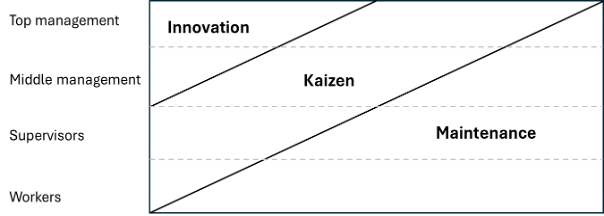
The classic approach in business, he said, is to completely separate the roles of maintenance and innovation, two functions in the company that traditionally ignore each other. Toyota has managed to build a bridge by introducing kaizen between the two—an opportunity for engineering to learn from those who use and maintain machines and equipment. And that is exactly what Cyril has in mind.
USING VALUE ENGINEERING TO ELIMINATE WASTE
Maintaining the site, or rather sites, is a real challenge. Aramisauto operates in six countries and maintains five sites, one of which is shared between France and Belgium. The upcoming arrival of Spain at this shared site is a great opportunity to give it a refresh.
The aim is to reduce engineering waste and unnecessary complexity and to merge into a single site. Hence, the idea of approaching each page and each block with a value engineering approach to eliminate the unnecessary. “It's not about forced merger, but rather about creating an efficient shared site that will make others want to adopt it,” Cyril says.
The challenges are not so simple: several countries need to be aligned in terms of regulations but also in terms of solutions to typical problems. One common problem is that of being visible, of making oneself known—a problem that Belgium has approached with a fairly traditional car dealer-type approach by introducing a showroom, while France prefers less expensive points of sale and investing in marketing. “It's a real challenge in terms of attractiveness,” says Cyril. “A website allows you to show many more models in much less time than in one or more showrooms. And also in terms of productivity, because physical stock in showrooms is expensive, requires square metres, and checking out several models takes time.”
“In France, it's still tricky to talk about productivity and cost reduction, because the idea is associated with working harder and putting more pressure on people. I'm talking more about making life easier for customers and employees by eliminating low-value-added tasks and obstacles to fluidity.” - Romain Boscher
The block-by-block approach required a lot of negotiation with the countries. Clara, one of the product managers, made maximum use of visualization and PDCAs to finalize decisions. The difficulty in this type of negotiation is to distinguish between the “legacy” layers (to be abandoned) and the core of the “heritage” engine (to be retained). Her visualization panels attempt to make the situation as factual as possible.

THE 6-POINT KAIZEN TO IMPROVE THE SITE
Beyond maintenance, we also need to think about improving the site’s functionality. The team began by working on a QFD (Quality Function Deployment) matrix. Critical customer expectations were listed, and the technical means or functionalities to meet them were cross-referenced with these expectations. “The main benefit of this exercise,” Cyril explains, “is that it allows us to agree on these points and create a shared vision that we can build on.” They also assessed their positioning relative to the competition on each of the critical expectations and thus identified the weaknesses that needed to be addressed.
“The QFD matrix is a very useful exercise for refining and converging on customer expectations and critical functions: if we have high customer expectations and we consider ourselves to be poor at responding to them, it allows us to see what we need to work on. It's an exercise that we do at Comex and that we encourage in all areas of the company.” - Romain Boscher
These weaknesses are all topics that a 6-point kaizen can address: analysis of the current method, new ideas, test plan, implementation, validation. The latest kaizen project, led by Jérémie, the product managers’ team leader, focuses on a common frustration experienced by customers, when they select their search criteria only to arrive at a page displaying a frustrating “no results found” message. It is this blank page effect, this dead end, that the kaizen seeks to eliminate. I can see it displayed on a board, with the options considered, the methods to be tested, and the results.
ANTICIPATING THE RISKS OF DISRUPTION
Aramisauto has always made a point of embracing new technologies, both out of preference and out of a need to not be caught off guard by a disruptive approach that would change the customer shopping experience. Whether it's a bubble or a revolution, therefore, AI cannot be ignored. In the future, potential customers may use new channels to search for a vehicle: how can Aramisauto be spotted by Large Language Models (LLMs) such as ChatGPT? How can they measure their attractiveness to LLMs in the same way they did with Google's SEO (Search Engine Optimisation)? For now, the team is focusing on one indicator: visits to their site from an LLM.
Yohan, one of the product managers, is currently leading this exploratory work. “What will attract an LLM to the site? The relevance of the content, of course, but also the ease with which a robot will be able to scan the site's architecture. For now, LLMs are black boxes; we lack experience and perspective,” he tells me. The only way to analyze their behavior is to make all kinds of assumptions about what could increase traffic from LLMs and test them one by one. Always just one change and one test, or the team won’t be able to attribute a result to a specific cause–a truly scientific approach. For example, I see on the board a hypothesis formulated by the team: “What if we added an LLM.txt file with the code architecture, would that facilitate the arrival of LLM entries?” The test failed, and the team has already moved on to the next test.
The team has also been working on a new customer interface based on an LLM: potential customers describe their needs in terms of budget, usage, mileage, engine type, options, etc. in a conversational mode. The application, which is directly connected to the Aramisauto catalogue, searches the stock in real time and offers them a selection.
As Cyril says: “The LLM's conversation with the customer creates a unique, completely personalized experience for them. Each customer has their own context, desires, experience and constraints, and these elements are captured in a conversational mode rather than through navigation on the site.”
“We are constantly raising our ambitions to improveour customers' experience, teach our employees new things, and guide themtowards greater autonomy in their work.” - Romain Boscher
The experience of Cyril and his team reminds us how the values and driving force behind TPS can be a true supporting guide for a manager in a new position: visualizing to understand the status quo, eliminating unnecessary processes or steps through repeated PDCAs (maintenance), taking the user's point of view to improve value (kaizen), and preparing for future disruptions (innovation). The idea is to constantly strike a balance between these different activities, so as not to overwhelm teams with execution, at the expense of exploration.
THE AUTHOR

Read more


FEATURE – The planet is warming at an unsustainable rate, pollution is increasing, wildlife populations and arable land areas have plummeted, and our oceans are filling with plastic. Can Lean Thinking help?

NOTES FROM THE (VIRTUAL) GEMBA – In the last of her series of virtual gemba walks, the author learns how a hospital in the Caribbean island of Martinique relied on Lean Thinking in its fight against the Coronavirus.

FEATURE – While at Starbucks, the author learned the importance of collaboration among the key functions of Operations, HR and Finance to advance a lean transformation.

FEATURE – In this compelling read, the author explains how “centerlining” tools and settings can reduce variation in a process and avoid having to constantly seek adjustments à la McGyver.
Read more

NOTES FROM THE GEMBA - The author's visit to Aramisauto's Nemours plant reveals how a lean system built around flow, quality, and people development is turning the complexity of used-car reconditioning into a competitive advantage.
NOTES FROM THE GEMBA – Catherine’s gemba walks are back after the summer break. This month, she visits a start-up that is using lean to manage its growth, and learns about its management’s extraordinary turnaround.

NOTES FROM THE GEMBA – In Part 1 of this mini-series on Aramisauto, the author explores how the company transformed its supply chain through pull flow, daily management, and problem solving.

NOTES FROM THE GEMBA – The author explores how France’s Lean community evolved through gemba practice, kanban-driven engagement, communities of practice, and a flywheel model turning shared learning into momentum.